On Saturday I attended the BTO Ireland Birdwatchers' Conference at Oxford Island, on the shores of Lough Neagh. This year’s conference was entitled, “Movement and Change: An update on some bird research and bird surveying in Ireland”.
A fantastic turnout of over 180 delegates listened to a wide range of great speakers, including Chris Murphy who spoke about the recent additions of Great-spotted Woodpecker and Little Egret to the list of breeding birds in NI, followed by Graham Appleton from BTO who highlighted some distressing declines which have been flagged up by the recent Atlas, including Curlew, Woodcock and Irish Sea Common Terns.
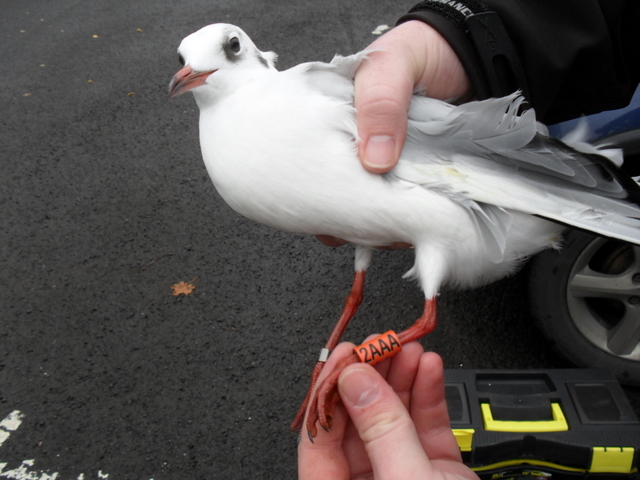
John O’Halloran from UCC showed that evidence has indicated that a lengthening season in grass growth as resulted in Whooper Swans now arriving earlier in autumn and departing earlier in spring. I also learned that the first person ever to fit a colour-ring to a bird was a COLOURBLIND Irishman named JP Burkitt in the 1920s – brilliant! Without Burkitt, I may not be undertaking my colour-ringing project of Black-headed Gulls, who knows?!
Eimear Rooney updated everyone on her fantastic PhD study into Buzzard ecology in north-east Ireland, estimating that there are 2128 breeding pairs on the island of Ireland and that, unsurprisingly, the main prey items in their diet are corvids and rabbits. She also showed some interesting, if contrasting, movements of wing-tagged birds, with some travelling over 100km and others staying close to the nest, travelling less than 0.5km. Eimear’s Buzzards are tagged with a yellow wing-tag on the right wing and an orange or blue tag on the left, depending on the year it was born.
 |
| Eimear with 2011 bird #49 |
Tony Murray from NPWS spoke about trials and tribulations of managing Lady’s Island Lake in Wexford for breeding terns and a colony of over 1600 pairs of Black-headed Gulls, in particular how managing the water levels correctly can prove the difference between success or complete and utter devastation. This summer while helping with nest counts on RSPB Larne Lough Islands, I was lucky enough to recover a dead adult Sandwich Tern which had originally been ringed at Lady’s Island Lake in 1998 as a chick.
Phil Atkinson from BTO told us about some of the magnificent tracking projects currently being undertaken by BTO, including tracking Swifts and the now famous Cuckoos! I was particularly interested in the Cuckoo project as I got to ring a female Cuckoo which was fitted with a satellite pack as part of this ground-breaking work. Unfortunately, Idemili as she was named, was recovered near London after being attacked (we don’t know what by) and was subsequently rehabilitated and released without her back-pack. You can read more about Idemili’s amazing story by clicking here.

Jenny Gill then told everyone about their work colour-ringing Black-tailed Godwits and some of the amazing results they have found, including where birds over-winter and on which habitats they choose to feed. Make sure you check any Black-tailed Godwits you see for colour-rings and more importantly...make sure you report your sighting! You can read about my recent sighting of one of Jenny et al's colour-ringed Blkwits by clicking here.
Kendrew Colhoun enlightened us all of the work looking at that tough little wader, the Purple Sandpiper. Through tracking individuals, they have found that birds over-wintering on the west coast of Ireland are from Canada and that they can fly non-stop for five days from Greenland to Ireland – amazing for a bird that weighs an average of 70g.
Mary Montague informed the audience of her fascinating work looking at noise pollution and how it affects birdsong. Mary showed that by being exposed to pre-recorded traffic noise, a singing Great Tit will respond with a much shriller song. Absolutely intriguing work.
Finally, Shane Wolsey told everyone about the projects we undertook on Copeland Bird Observatory this year to encourage breeding terns and prospecting Puffins. That’s all I’m telling you about those two projects because if you want to learn more, you’re going to have to visit this spectacular island.
 |
| Spot the real Puffins... Photo by Kerry Leonard |