Tuesday, 21 May 2013

Swedish bird in Belfast!

Declan Clarke, a ringer from County Down, got in touch to let me know about a ringed Black-headed Gull which was found dead on Duncrue Street in the harbour area of Belfast on 18 January this year.

The ring was inscribed with the number, 6426829, and the address read Rikmuseum Stockholm, which indicated that this bird had been ringed in Sweden.

Declan reported the find through the BTO and got word back last week.

Sure enough, this bird was originally ringed as a chick on 31 May 2011 at Sunnana, Mellerud in Sweden.  The distance between ringing location to where it was recovered is 1214 km and time between ringing and recovery was 598 days.

Blue - Sunnana, Mellerud, Sweden
Red - Belfast, Northern Ireland

This also means that this is yet another country to add to the list of where wintering Black-headed Gulls during winter 2012-13 originated, as confirmed through rings/colour-rings being read, taking the total to nine (Lithuania, Poland, Norway, Iceland, England, Scotland, Ireland, Belarus and Sweden). 

Many thanks to Declan for passing on the information.

Wednesday, 15 May 2013

Black-headed Gull - 2AAR (an update)

I have received another email from the Polish Bird Ringing Centre in Gdańsk with a second (or should that be first?!) sighting of 2AAR.

The original email which I received about this bird reported that it had been seen at Hryniewicze on 11th April, but it turns out that this was actually the second sighting of the bird in Poland.  Artur Blad had seen 2AAR at Kowale in Gdansk 6 days before, on 5th April.

Red - Antrim, NI (ringed here 21.12.12, last recorded here 12.03.13)
Yellow - Gdansk, Poland (seen here 05.04.13)
Blue - Hryniewicze, Poland (seen here 11.04.13)

CLICK ON IMAGE FOR LARGER VERSION
Photo by Artur Blad

Photo by Artur Blad

This is fantastic news and I'm delighted to receive both reports.  Many thanks to Artur and Michal for reporting their sightings and to the Polish Bird Ringing Centre for passing on the information.

Thursday, 9 May 2013

White-tailed Eagle - White/Black J

There are various methods for uniquely colour-marking birds to identify and track movements of individuals, and using coded colour-rings such as those used on the Black-headed Gulls is just one.

Another method, and one which is used widely for raptors, is wing-tagging.  Fitting coloured tags to the patagium of the bird with a code printed on them allows observers to tell where a bird has come from, the year it was born and if close enough to read the code, identify the invidual bird.

At the start of last week I was out one evening at Capanagh near Larne in County Antrim with my 16-month old son watching the Ravens going into roost.  As we were heading home I saw a bird in the distance being mobbed by what I assumed was a Hooded Crow. 

I quickly realised that the bird mobbing was actually a Raven and the bird it was mobbing was a White-tailed Eagle (WTE)!  The bird flew across a clearing and landed at the edge of the wood.  Unfortunately the sun was setting directly behind the trees and it was very difficult to see the bird properly.

Mobile phone reception at Capanagh is non-existent, so I shot to the top of Glenarm Glen and called Neal Warnock, a friend and colleague who lives in Larne.

A short while later, Neal appeared and I showed him where the bird had gone in and I headed home to put Ruben to bed. Neal hung around for another hour or so until the sun set and managed to not only see the bird, he also got this photo.

Photo by Neal Warnock

You can clearly make out the wing-tag, White J (although it looks light blue in the photo!).

I called Allan Mee, the WTE Project Officer in Co. Kerry and reported the sighting and he was able to tell me that this bird was a female brought over from Norway and released in Killarney National Park in 2011 by the Golden Eagle Trust as part of the reintroduction project.

The next day, Neal was conducting wader surveys near Capanagh and was lucky enough to see and photograph the eagle again as it flew overhead!

Photo by Neal Warnock


This is the second WTE I've seen in Northern Ireland, after seeing a bird near Lough Neagh in 2009 and the sighting is made even sweeter by the news which broke yesterday that two pairs of WTE have hatched chicks in Counties Kerry and Clare.  This is the first time wild WTE have hatched chicks on the island of Ireland in 110 years and is a fantastic milestone for this wonderful project.

You can find out more about the WTE project by visiting their website and you can see a video and photos of the nesting WTE by going to their Facebook page.

Photo by Kevin Mawhinney

Wednesday, 1 May 2013

Copeland Common Gull colour-ringing project

Since 2009, Shane Wolsey has been colour-ringing Common Gulls that breed on Big Copeland, the largest of the Copeland Islands, just off the coast from Donaghadee, Co. Down.
 
With approximately 800 pairs, Big Copeland has the largest breeding colony of Common Gull, Larus canus, in Ireland and the aim of Shane’s colour-ringing project is to build up a picture of the population dynamics of this colony:
  • Why has the colony grown during the past two decades? 
  • What is the reproductive success rate of this colony? 
  • Where do the young and adults winter?
 
The 2009 season was rather experimental, with 12 adults and six pulli being colour-ringed.  These 18 birds were fitted with yellow colour-rings with black lettering on the left leg and a metal BTO ring on the right leg. 
 
2BBC at Millisle, January 2012
Photo by Brendan Dunlop
 
As the yellow rings did not show up well against the green-yellow of the bird’s leg, it was decided to change colour, and since 2010, dark blue rings with white lettering have been used - again with the colour ring on the left leg, and the BTO ring on the right. 

2HSF at Millisle, April 2013

A total of 196 birds have been fitted with blue colour-rings on Big Copeland (13 adults and 183 pulli), although only 14 birds were ringed in 2011 due to a storm in late May badly disrupting that year’s breeding season.
 
Until the start of this year, there had been relatively few re-sightings, however, since January 2013 Copeland birds have turned up in quite a number of places. 


2ACA at Millisle, April 2013
 
Millisle in County Down is a favourite location.  There have been a couple of birds (2BBC and 2ADX) there throughout the winter, with the occasional appearance of other individuals (2AAC, 2ACA and 2HSF).  There has also been a considerable build-up of Common Gulls, many of them ringed, at Millisle during March and April – are these all Copeland birds getting ready to get back on the breeding grounds? 
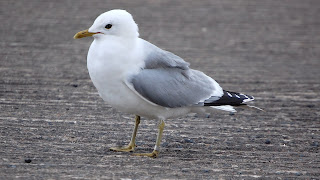
BTO ringed Common Gull at Millisle, April 2013

A small number of Copeland birds have also turned up at Duncannon Strand, Co Wexford.  2AXV and 2HVP were there in January, and 2HPX in February and 2ANN was at Sarsfield Lock, River Shannon, Limerick City in January.
 
The furthest travel bird to have been reported so far is 2AXH which turned up at Kervigen Beach, Finistère in France on 8th January this year!
 
2ADX at Millisle, March 2013

If you see any of Shane's study birds, you can report them to him by emailing shane.wolsey@btinternet.com